$192,000 for a slide deck full of green arrows.

Eight thousand dollars a month. Twenty-four months. $192,000 total. In exchange: 40% more impressions, 200 more ranking keywords, a monthly report you can email your board.
Revenue from organic search: flat. Deals closed from someone who mentioned reading your content: zero.
You paid for two years of that. You kept going because the reports looked good and canceling means starting over. Now you own a spreadsheet full of vanity metrics and a competitor who’s eating your organic pipeline.
The click is dying. Your SEO agency didn’t tell you.

58% of searches end with zero clicks. 65% of Google searches end with no site visit at all. The AI answered the question on the results page and the buyer moved on.
Your competitor was in that answer. You weren’t. The buyer never compared. They went with the name the AI gave them.
If your SEO team is still chasing keyword positions on a page nobody visits, they’re optimizing for a game that stopped being played eighteen months ago.
Google just changed the rules. Permanently.

In late 2023, Google filed the patent (US20240256582A1) that explains how AI Mode works.
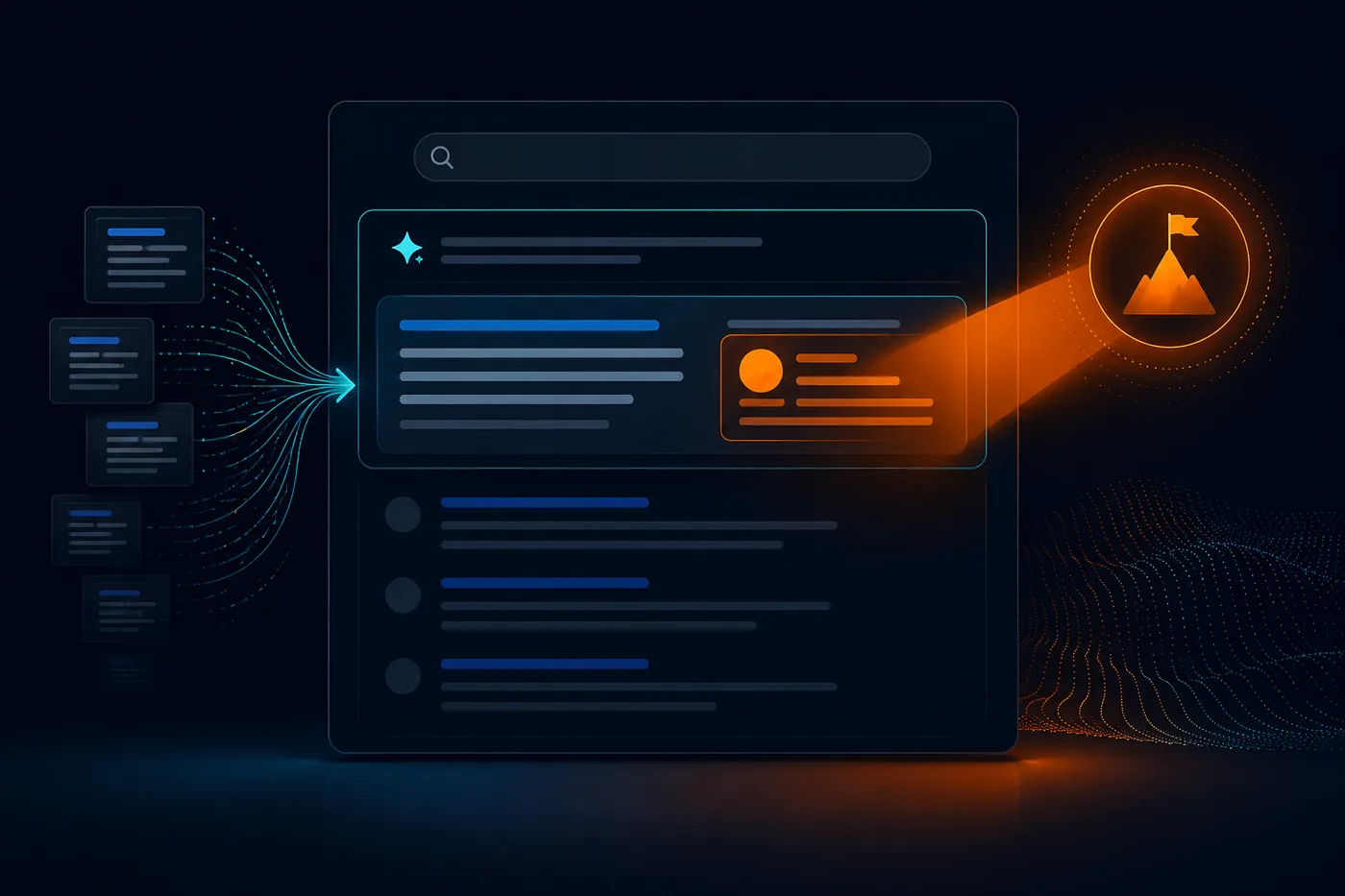
The AI generates answers from a synthesized understanding of the web. It decides which sources to cite and which to ignore. Citation eligibility depends on structural clarity, , and trust signals. The old ranking-first model is one input among many now.
Traditional SEO signals still matter. Technical health, backlinks, , E-E-A-T. All still required. Ranking in the top ten is the entry ticket now, not the finish line.
This is what Miss Pepper does most.
SEO is our core service. Every other capability we sell compounds on top of a site that ranks and gets cited. If your organic pipeline is the difference between growing and stalling, this is the page.
What we do
Five disciplines. Run as one system. All the SEO work you’d expect from a serious agency, plus the modern layer that decides whether AI answer engines cite you.
Technical SEO (the foundation nobody sees)
Site health, crawl efficiency, index coverage, . The plumbing that decides whether Google bothers to consider your pages. Audit, fix, monitor. When something breaks (a bad deploy, an accidental noindex), an alert fires before it costs you rankings.
On-page SEO (measured, not guessed)
Real , not a keyword-stuffed sitemap. Internal linking that routes authority to the pages that need to convert. Schema markup that machines can read. Headings, meta, and page structure built for how modern search engines and AI answer engines parse content.
Content SEO (the compounding layer)
Topical authority built through real coverage, not a blog post a month. Cluster maps that dominate a topic instead of dabbling in twenty. Content structured to answer the questions your buyers search, in the format the answer engines want to lift.
Off-page SEO (the trust signal)
Earned links from publications that matter for your category. Digital PR that gets you cited in real journalism. Not directory spam. Not private blog networks. Links that pass authority because they come from sites that already have it.
AI Answer Engine Optimization (the modern layer)
Direct-answer format at the top of every page. on every question block. Entity clarity through sameAs links to Wikipedia and Wikidata. Cited specifics instead of hedge language. Everything an AI answer engine looks for when it decides which source to lift into an AI Overview, a ChatGPT reply, or a Perplexity citation.
Here’s what makes ours different. Most SEO agencies guesstimate. They pick a handful of obvious factors, apply them, and hope.
Two people can eyeball the height of a coffee table. One of them will be right when they pull out the tape measure. We’re the ones with the tape measure.
This is science and math. Not opinion.
If SEO is the foundation, this is the roof. Together they’re the difference between ranking well and being the one the buyer finds.
How we measure it (so a CFO can read it)

Not impression counts. Not “ranking on 200 keywords.” Both lie. Five things matter.
Organic revenue
Revenue attributed to organic search, tracked from first touch to closed deal. If SEO isn’t producing revenue, we don’t call it working.
Non-brand organic traffic
Not the traffic from people searching your company name. The traffic from buyers searching for what you sell who didn’t know your name yet. This is the number that separates real SEO from fake SEO.
Citation frequency across AI engines
How often your brand gets named in AI Overviews, ChatGPT, Claude, and Perplexity answers relevant to your category. Tracked weekly.
Share of voice
Where you appear relative to competitors, on both traditional search and AI answers. Rising share of voice against a named competitor is the leading indicator that this is working.
Brand-search velocity
Search Console impressions on your brand name. When AI mentions you, buyers Google the brand to verify. Rising brand searches with flat clicks means the AI layer is landing.
This is for you if
- You depend on organic visibility for growth
- You compete in a crowded or high-intent market
- You care about revenue, not impressions or rankings
- You want compounding results, not sugar highs
- You’ve been burned by an agency that reports on rankings and never on revenue
This is not for you if
- You want instant wins with no site changes
- You only care about keyword positions
- You want set-it-and-forget-it SEO
- You aren’t willing to invest in the content and structural work that actually moves the needle
If any of the second list is you, don’t book the call. It’ll waste both our time.
Common questions
What’s the difference between SEO and AI Optimization?
SEO gets you ranked in Google’s blue links. AI Optimization gets you cited in the AI-generated answer that sits above the blue links. Same trust signals, different content structure. Modern SEO includes both. Anyone selling you one without the other is selling half a service.
Do I still need traditional SEO if my buyers are moving to AI?
Yes. AI answer engines still lean heavily on Google’s ranking systems to source content. If your site doesn’t rank, the AI never considers you. Technical health, backlinks, and topical authority are still required. Ranking well is table stakes, not the finish line.
How long until I see results?
Technical fixes and on-page improvements can move rankings within weeks. Content and topical authority take 3 to 6 months. AI answer engine citations start showing up 4 to 8 weeks after direct-answer format and schema go live, for pages already ranking in Google’s top 20. From zero authority, plan on 6 to 12 months for meaningful compounding.
What if I’m ranking well already?
Good. That’s the foundation. The next question is whether you’re getting cited in AI answers for the same queries you rank for. Most sites that rank well don’t. Which means a competitor with weaker rankings but better structural work is stealing your buyer at the top of the results page.
Do you handle content?
Yes. We produce the content built to rank and get cited. If you already have a content team, we work with them on the structural and topical strategy. If you don’t, we handle the full content operation.
Do you handle link building?
Yes. Earned links from publications that matter for your category, and digital PR that gets your brand mentioned in real journalism. No directory spam or private blog networks. Nothing Google will penalize you for.
Which AI engines matter?
Google’s AI Overview by a wide margin. ChatGPT next. Perplexity and Claude matter less by volume but more by intent. We optimize for AI Overview first. The others usually follow because the structural work overlaps.
How is your measurement different?
We track organic revenue, non-brand traffic, AI citation frequency, share of voice, and brand-search velocity. Not impression counts. Not the number of keywords you rank on. Every metric ties to money.
Can I bring my existing SEO agency and add the AI layer?
Depends on your agency. If they’re doing real technical and content work, we can layer AI Optimization on top. If they’re selling you keyword ranking reports and calling it SEO, they’re the reason the site isn’t producing revenue. Either way, we tell you on the fit call.
What’s included in the fit call?
A live look at your Search Console, one competitor’s search footprint, and a quick check of how you show up in AI answers for your top queries. Dan tells you where the biggest gaps are and what fixing them would produce. No pitch deck.
How to do SEO as a beginner?
Start with the basics: pick a niche you understand, do keyword research to find what your audience is actually searching for, write clear content that answers those queries better than the current results, and get the on-page fundamentals right (titles, headings, internal links, page speed). Then build a small number of quality backlinks and be patient. Beginners fail more from spreading effort thin than from picking the wrong tactic.
What are search engine optimizations?
Search engine optimizations are the changes you make to a website and its content so it appears higher in search results for queries that matter to your business. They fall into three broad groups: on-page (content, structure, titles), technical (speed, crawlability, indexing), and off-page (backlinks and mentions). Increasingly, a fourth layer matters — how AI assistants read and cite your content, which is what we call generative engine optimisation (GEO).
What are the 4 types of SEO?
A common breakdown is on-page SEO (content and structure), off-page SEO (backlinks and reputation), technical SEO (crawling, indexing, page performance), and local SEO (Google Business Profile, citations, local pack ranking). Some lists add mobile SEO or e-commerce SEO as their own categories. The types overlap; a solid strategy usually pulls from all of them rather than choosing one.
Can I do SEO on my own?
Yes, if you are willing to spend the time to learn and apply the fundamentals consistently. Small business owners and solo operators regularly run their own SEO by focusing on clear content, solid on-page structure, and steady publishing. Where DIY hits limits is scale, technical complexity, and specialist areas such as backlink acquisition. Doing it yourself early is fine; hiring specialists becomes cost-effective when the site outgrows what one person can maintain.
Can ChatGPT do SEO?
ChatGPT can help with parts of SEO — brainstorming keywords, drafting content, generating outlines, summarising competitors, and writing meta descriptions. It does not replace strategy, technical audits, or judgement about what a real user wants from a page. Used with clear briefs, it speeds up production; used unedited, it produces the kind of generic content Google’s helpful-content updates target. Treat it as an assistant, not the SEO team.
Can SEO be self-taught?
Yes, and most working SEOs are largely self-taught. There is a huge volume of free material — official documentation from Google, industry blogs, YouTube channels, and case studies. Structured courses can shortcut some of the learning, but they don’t replace hands-on practice on a real site. The fastest way to learn is to run SEO for a project you own, so the results (and mistakes) are your own.
Is SEO replaced by AI?
SEO is being reshaped by AI, not replaced. What has changed is that AI assistants (ChatGPT, Google’s AI Overviews, Perplexity, Claude) now answer many queries directly, so traditional blue-link traffic is under pressure. What matters now is being one of the sources those AI systems cite. That is generative engine optimisation, and it is the layer we build for clients at Miss Pepper AI. Traditional SEO fundamentals still apply underneath.
Is SEO difficult to learn?
The core concepts of SEO are straightforward — write for the user, make your site crawlable, earn credible links, be patient. What makes it feel hard is that results take months, best practice keeps shifting, and there is a lot of contradictory advice online. Learning by doing on a real site — even a small one — beats reading about it. Give it six months of consistent work and the fog lifts.
What is the 80 20 rule of SEO?
Applied to SEO, the 80/20 rule usually means about 80% of your results come from 20% of your actions — typically choosing the right keywords, publishing genuinely useful content, and earning a small number of authoritative links. Endless tweaking of meta tags and minor technical settings falls in the 80% that produces the last 20% of results. Focus on the fundamentals first and revisit the small stuff later.
What are the 3 C’s of SEO?
The 3 C’s most commonly cited are content, code, and credibility. Content covers what is actually on the page and how well it answers the query. Code covers the technical side — crawlability, speed, structured data. Credibility covers signals of trust and authority, especially backlinks and brand mentions. Get all three right in parallel; strength in one cannot fully offset weakness in another.
Is SEO an IT skill?
SEO sits at the intersection of marketing, content, and IT rather than living purely in one. The technical parts — server settings, crawlability, structured data, JavaScript rendering — overlap heavily with IT. The strategic and content parts belong to marketing. Which department owns SEO usually depends on the business, but successful SEO teams tend to include both marketing thinking and technical fluency.
Which type of SEO is best?
No single type of SEO is “best”; the right mix depends on your business model. A local service business leans on local SEO. A content publisher leans on on-page and off-page. An e-commerce brand blends technical, on-page, and product-page optimisation. Nearly every strategy still needs solid technical foundations, because a site that cannot be crawled cannot rank regardless of how good the content is.
How to start SEO as a beginner?
Begin with a single site — your own, a client’s, or a practice project. Learn Google Search Console and a basic keyword tool. Publish content that answers real questions your audience searches for, and structure it so search engines understand it. Track a small number of meaningful keywords over months, not days. Real learning comes from watching your own decisions play out in the data, not from reading more theory.
What are common SEO mistakes?
Common mistakes include chasing keywords with no clear business intent, publishing thin duplicate content, ignoring technical basics such as crawlability, over-relying on backlink shortcuts, and abandoning strategies before they have time to work. Another growing mistake in 2026: writing purely for search engines while ignoring how AI assistants extract and cite content, which increasingly drives visibility. Fix the fundamentals before optimising anything clever.
Is SEO worth the money?
SEO is worth the money when the site serves a real business, targets queries with commercial intent, and the investment is sustained long enough to compound. Short-term SEO spend rarely produces returns because results take months. Businesses that stop after three months tend to be disappointed; businesses that stay the course for a year or two often see it become their most cost-efficient acquisition channel.
What AI tool is best for SEO?
The best AI tool for SEO depends on the task. General-purpose assistants (ChatGPT, Claude) are strongest for content, outlines, and briefs. Dedicated SEO platforms have added AI features for keyword research, content optimisation, and technical audits. Because tools change fast, we don’t nominate a single winner here. What matters more is having a workflow that combines AI for speed with human judgement on strategy.
What is the 30% rule in AI?
The 30% rule is a rough guideline that says AI should handle around 30% of a knowledge task while humans handle the remaining 70%, particularly where judgement or brand voice matters. Some versions flip the ratio depending on the task. In an SEO context it is a useful reminder — AI can draft, sort, and summarise, but the strategic calls (what to write about, why, and how it fits the site) still belong to a human.
How do seos make money?
SEO practitioners typically make money in one of four ways: in-house salaries running SEO for a company, agency salaries or freelance retainers running SEO for multiple clients, consulting or one-off audits, or affiliate/own-site SEO where they rank sites they own and monetise the traffic. High earners usually specialise — technical SEO, local SEO, e-commerce, or programmatic — rather than staying generalist.
Will SEO be replaced by AI?
SEO as a specific tactic set is evolving into a broader discipline that includes optimising for AI assistants and generative search. The core skill — helping a business be found when someone has a need — is not disappearing, but the surfaces have expanded beyond Google’s blue links. Practitioners who add generative engine optimisation (GEO) to their skill set are in a strong position; those who don’t will feel the squeeze.
How quickly can I learn SEO?
You can learn the fundamentals in about three months of consistent study and practice. Enough to be usefully hired as a junior SEO usually takes six to twelve months. Mastery — the point where you can independently strategise for a business and predict outcomes — comes with years of doing the work. Faster paths exist for people already strong in content or in technical development, since half the skillset transfers.
Is SEO a hard skill?
SEO is a mix of hard and soft skills. The technical and analytical parts (audits, structured data, tracking) are firmly hard skills. The strategy, content judgement, and stakeholder management parts are soft skills. Employers typically list it as a hard skill for hiring purposes because the outputs are measurable. Strong practitioners have both, which is why the discipline rewards curiosity as much as raw technical knowledge.
What has replaced SEO?
Nothing has replaced SEO; the field has expanded. Traditional SEO (ranking in Google’s blue links) still matters, but it now sits alongside generative engine optimisation (being cited by AI assistants), answer engine optimisation (voice and featured-snippet-style responses), and social search (TikTok, YouTube, Reddit as discovery layers). What has changed is that “SEO” is now shorthand for a broader discovery strategy, not just Google rankings.
How do I learn SEO as a beginner?
Read the free Google Search Central documentation cover to cover. Pick one small project — your own site, a friend’s, or a practice site — and apply what you learn week by week. Add one credible blog or newsletter to your reading list. Track your work in a simple document so you can look back at what you tried. Learning by doing on a real site beats every course and video.
Is SEO a stressful job?
SEO can be stressful because results are slow, competitors keep moving, algorithms change without warning, and clients or stakeholders often expect faster wins than SEO can deliver. In-house roles tend to be less pressured than agency or freelance work with multiple demanding clients. The stress is more about expectation management than the technical work itself; setting realistic timelines with stakeholders removes most of it.
Is SEO higher than CEO?
SEO is not a job title in the executive hierarchy; it stands for search engine optimisation, which is a marketing discipline. CEO stands for Chief Executive Officer, which is the senior-most executive role in most companies. The two acronyms sit at different levels entirely — SEO is a function inside a business; a CEO runs the whole business. If you are looking at C-suite titles, SEO does not belong on that list.
What are the 4 pillars of SEO?
A common 4-pillar model lists: technical SEO (crawlability, speed, structured data), on-page SEO (content and page-level optimisation), off-page SEO (backlinks and authority signals), and content strategy (what you publish and why). Some sources swap content for user experience, or add local as a fifth pillar. The exact split matters less than the principle: strong SEO needs work across foundations, content, and reputation in parallel.
What is a good SEO score out of 100?
SEO scores in tools such as Yoast, Rank Math, SEMrush, or Ahrefs are internal ratings from those tools rather than a Google metric. A “good” score varies by tool; many aim for green ratings around 80+. These scores are useful as checklists but poor predictors of ranking on their own. A page can score 100 in a plugin and rank poorly, or score 60 and rank well. Use scores as guides, not goals.
What are the top 5 SEO strategies?
Reliable long-term strategies include: publishing genuinely useful content aligned to search intent, building topical authority around a clear niche, earning credible backlinks through work worth linking to, keeping the site technically clean (speed, mobile, structured data), and increasingly, optimising for how AI assistants extract and cite content. Which of these to weight depends on your business; most sites need at least four of the five running in parallel.
What are the 5 pillars of SEO?
A common 5-pillar model expands the classic four with user experience: technical, on-page, off-page, content, and UX. Some lists swap in local SEO or E-E-A-T (Google’s experience-expertise-authoritativeness-trust framework) as the fifth pillar. The models overlap. What matters more than the label count is that a strong SEO plan addresses foundations, content, reputation, and how real users interact with the site.
What are the two main types of SEO?
The simplest split is on-page SEO (what you do on the site — content, structure, technical setup) and off-page SEO (what happens beyond the site — backlinks, mentions, brand signals). Some sources call the split on-site vs off-site. Almost every ranking factor fits into one of these two categories. Successful SEO needs work on both, though the balance shifts by niche and competition level.
What are the 4 types of keywords?
A common classification is by search intent: informational (people looking for answers), navigational (looking for a specific site), commercial (comparing options before buying), and transactional (ready to buy). Some frameworks slice keywords by length instead — short-tail, mid-tail, long-tail, and question-based. Matching content to intent is more important than the label; a transactional page will not rank for an informational query and vice versa.
Can I do SEO by myself?
Yes, especially for a small site or a personal project. Solo SEO is doable if you focus on the fundamentals: pick a real niche, do honest keyword research, publish useful content consistently, keep the site technically clean, and build a modest number of quality links over time. What is hard alone is scale, competitive backlink work, and complex technical projects. For those, hiring in specialists pays off.
Is SEO Career hard to get into?
Breaking into SEO is easier than many career paths because there is no formal qualification required and the discipline rewards demonstrable results. What gets you hired is a portfolio: a site you ranked, an audit you wrote up, or a case study on a project. Formal courses help; visible work helps more. The bar to enter is low; the bar to stand out and earn well is doing genuinely good work over time.
Is SEO a remote job?
SEO is one of the most remote-friendly roles in marketing. The work — audits, keyword research, content briefs, technical reviews, reporting — is entirely digital, and most tools are cloud-based. In-house SEO roles at larger companies sometimes require occasional office presence; agency and freelance SEO is very often fully remote. It suits distributed and flexible working better than most marketing disciplines.
Which SEO company is best?
There is no universal “best” SEO company; the right fit depends on your niche, size, and budget. Larger agencies handle scale and enterprise clients well; smaller specialists often deliver stronger results for niche or mid-market businesses. Since agency quality varies widely, we don’t nominate names here. Look for case studies in your industry, ask for reference clients, and be wary of anyone promising specific rankings.
Which website has the best SEO?
“Best SEO” is context-dependent — it depends on which query and which market you look at. Wikipedia, major news sites, and category-leading e-commerce brands consistently rank across huge volumes of queries because of their domain authority and content depth. Smaller sites can outrank them for specific queries where they are more relevant or more focused. Rather than copy any single site, study what dominates for your target queries.
What is the most popular SEO tool?
The most widely used SEO tools are the paid platforms — Ahrefs, SEMrush, and Moz — alongside Google’s own free Search Console and Analytics. Yoast and Rank Math are the most-installed on-page SEO plugins for WordPress. Because tool popularity shifts and pricing changes, we don’t crown one here. Most professional SEOs use a combination: one paid platform for research, Search Console for real data, and a lightweight on-page plugin.
How do I teach myself SEO?
Read Google’s Search Central documentation to understand the source of truth. Follow two or three respected industry blogs. Pick a live site and apply what you learn week by week — audit, brief, publish, measure. Track your assumptions and results in a document. Real understanding comes from watching your own decisions play out over months on a real site, not from consuming more courses.
Which are the best SEO tools for a beginner?
Start with the free tools: Google Search Console (real data on your own site), Google Keyword Planner (basic search volume), and Google Analytics (traffic and behaviour). A free tier or trial of Ahrefs, SEMrush, or Ubersuggest opens up keyword and backlink research. Add a lightweight on-page plugin such as Yoast or Rank Math if you run WordPress. That stack covers 80% of what a beginner needs.
Can you get an SEO job with no experience?
Yes, though you almost always need to show that you have done the work rather than just studied it. A personal project that you rank, a documented audit of a public site, or a small freelance client is usually enough for a junior in-house or agency role. Employers care much more about demonstrable understanding than formal experience. Build something visible before applying.
What SEO practices should one avoid?
Avoid tactics that treat search engines as the primary reader rather than users — keyword stuffing, thin AI-spun content, buying low-quality backlinks, cloaking, and misleading titles that don’t match the content. These worked in earlier eras and now trigger algorithmic penalties. The safer test: would this look reasonable to a smart human reviewer, and does it genuinely help the person searching? If not, don’t ship it.
How to tell if a website has good SEO?
Signs of solid SEO include: fast load times, clear page titles and headings, clean URL structure, useful content that matches search intent, working internal links, mobile-friendliness, structured data where relevant, and organic traffic showing up in tools such as Ahrefs or SEMrush. A quick spot-check: search for the site’s core topics and see whether they rank. If they show up for their own bread-and-butter queries, the fundamentals are working.
What are the five golden rules of a website?
A common set of five: be clear about what the site does within seconds of arrival, be fast on mobile, be easy to navigate, be genuinely useful for the intended visitor, and be findable in search. Lists vary; the underlying principles do not. From an SEO standpoint, “findable” and “useful” carry the most weight, because a site that fails those two rarely succeeds regardless of how it looks.
How much should a small business pay for SEO?
SEO pricing for small businesses varies enormously — from cheap $200/month packages (usually low value) up to several thousand dollars a month for serious agency work. Freelance retainers commonly sit between these. Because prices depend on scope, industry, and provider, we don’t quote a single figure here. What matters more is whether the work is producing a return; a $500/month engagement with clear results beats a $3,000/month one with none.
How long does it take for SEO to work?
SEO typically takes three to six months to show early results, six to twelve months to produce meaningful traffic, and a year or more to compound into a strong channel for competitive niches. The timeline depends on your site’s starting position, the competitiveness of your keywords, and how consistent the work is. Anyone promising fast rankings is either working in an uncompetitive niche or overpromising.
What are the big 3 AI tools?
The three most widely used general-purpose AI tools are OpenAI’s ChatGPT, Anthropic’s Claude, and Google’s Gemini. Each has strengths — different reasoning styles, different context windows, different pricing tiers. For SEO work, most operators use one as their default and reach for another when the first hits a limit. The choice matters less than knowing how to brief them well and edit their output.
What 5 jobs will AI not replace?
Roles consistently expected to hold up include skilled trades (electricians, plumbers, HVAC), healthcare roles involving direct patient care, mental-health professionals, senior strategic and creative leadership, and complex sales and negotiation. Marketing and SEO fit the pattern where the tools reshape the job rather than eliminate it — the strategist who directs AI stays; the operator who competes with AI on speed alone struggles.
Will SEO exist in 5 years?
Yes, though it will look different. The underlying goal — helping a business be found when someone has a need — is not going anywhere. What is changing is that search is fragmenting across Google, AI assistants, social platforms, and voice. SEO is expanding into a broader discovery discipline that includes generative engine optimisation (GEO). Practitioners who adapt will thrive; those who don’t will feel the same squeeze as writers who ignored the shift.
Is SEO job hard?
SEO roles are moderately hard: the fundamentals can be learned in months, but the discipline stays challenging because algorithms change, results take time, and clients or stakeholders often want faster wins than the work can deliver. Technical SEO adds real complexity for anyone without a development background. It rewards patience, curiosity, and the ability to think in systems rather than tactics.
Can I learn SEO by myself?
Yes. Most working SEOs learned by combining free material (Google’s documentation, respected industry blogs, YouTube) with hands-on practice on a real site. Structured courses can shorten the path but do not replace the practice. The self-taught route works if you commit to running SEO on something real — your own project, a friend’s business, or a small client — and reviewing your results honestly.
Does SEO still work in 2026 with AI search everywhere?
Yes, and it matters more, not less. AI answer engines source most of their answers from pages Google already ranks. If you’re not ranking in traditional search, AI Overview and ChatGPT don’t cite you either. What’s changed is the finish line. Ranking well now gets you in the running for citations. It doesn’t guarantee clicks the way it used to. SEO plus AI optimization is the new stack. Doing only one of the two leaves half your visibility on the table.
What’s the difference between local SEO and traditional SEO?
Local SEO ranks you for searches with local intent (“plumber near me,” “dentist in Tampa”) and lives inside Google Business Profile as much as inside your website. Traditional SEO ranks you for non-geographic searches and lives mostly on your site. Local SEO leans heavily on reviews, citations (mentions of your name, address, and phone across the web), and proximity. Traditional SEO leans on content depth, backlinks, and technical health. Most small businesses need both.
How long does SEO take to work?
Realistic timeline: 3 to 6 months to see movement, 6 to 12 months to see meaningful traffic from a new campaign. Faster if you have existing domain authority and are targeting low-competition keywords. Slower if you’re starting from a new domain in a competitive niche. Anyone promising results in 30 days is either doing paid ads, targeting near-zero-volume keywords, or lying.
What is technical SEO and do I need it?
Technical SEO covers the parts of your site that affect whether Google can crawl, index, and understand it: site speed, mobile responsiveness, structured data, XML sitemaps, canonical tags, redirect chains, and Core Web Vitals. You need it. Content is what ranks, but broken technical foundations make good content invisible. Most small business sites have technical issues (slow load times, missing schema, broken redirects) that cost them rankings. A one-time technical audit and fix usually pays for itself.
What are the most important SEO ranking factors right now?
Content quality matched to search intent is still number one. Google’s algorithms are increasingly good at telling whether content actually answers the question. Backlinks from relevant, authoritative sites are still critical, though quality beats quantity by a wide margin now. Core Web Vitals and page experience matter. E-E-A-T signals (experience, expertise, authoritativeness, trust) matter more for YMYL topics (money, health, safety). And schema markup helps with AI Overview visibility more than direct rankings.
Can I do SEO myself or do I need an agency?
You can absolutely do SEO yourself if you have time to learn and are willing to spend 10 to 20 hours a week on it for the first year. The hard part isn’t the tactics. It’s the discipline of doing them consistently for 12 months before you see full results. Agencies exist because most business owners run out of patience or bandwidth. If you have neither, hire. If you have both and enjoy the work, DIY beats a bad agency.
What is Core Web Vitals and how do I improve mine?
Core Web Vitals are three Google metrics that measure how fast your site loads and how usable it feels: Largest Contentful Paint (loading speed), Interaction to Next Paint (responsiveness), and Cumulative Layout Shift (visual stability). Google uses them as a ranking factor and shows them in Search Console. The usual fixes: compress images, defer non-critical JavaScript, use a modern CDN, avoid layout-shifting ads or lazy-loaded content that jumps around, and pick a fast, well-maintained theme.